I have a bit of free time on my hands, so I decided to reinstate my 'green' blog. New name, new place, but I've copied all my old posts from the last one over here. Now, it's just a matter of having something to write about...
In the past, I've gotten my ideas from my collection of books and websites that I like to read - I'd find an interesting article or tidbit of information to share, or something to try and then give my personal take on it. But unfortunately, all of my books are in storage right now. I still have the web, but sitting in front of a computer when I have the opportunity to be outside, away from a desk... not so appealing.
So, what to write?
I have a few ideas brewing, but if anybody has some input, let me know in the comments. Heck, even if you don't have any input, I'd love to hear from you in the comments anyway, just to know you're interested.

Monday, June 14, 2010

Friday, January 29, 2010
Book Review: Food Rules
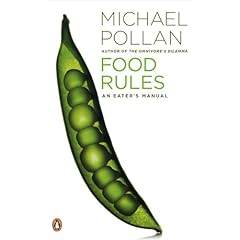 Michael Pollan, bestselling author of In Defense of Food: An Eater's Manifesto and The Omnivore's Dilemma, has published what is called a "definitive compendium of food wisdom." Food Rules is a short, easy-to-understand guide to eating real food and avoiding over-processed "food-like substances."
Pollan's mantra of "Eat food. Not too much. Mostly plants." was established after the extensive research he did for his previous books. He found that all the science and techno-babble about the nutritional value of food could be simplified down to its core: real food is what's important. Not the additives, the preservatives, the artificial, the pre-packaged - real food. This philosophy is reiterated again and again, with rules such as "Avoid food products that have ingredients that a third-grader cannot pronounce," and "It's not [real] food if it's called by the same name in every language (Big Mac, Pringles, Cheetos, etc.)"
The book not only discusses what to eat, but also how to eat. Pollan discusses the problem with "Western" food culture in the introduction, and breaks down the way we eat as one of the key issues alongside what we eat. Common sense wisdoms such as "Stop eating before you're full" and "Spend as much time enjoying the meal as it took to prepare it" encourage readers to pay attention to how they're eating to avoid overindulgence.
Pollan's previous works cover some of the same material, but go into much more detail regarding the science and statistics behind the reasons for avoiding processed foods. Food Rules is, in essence, the simplified version. Some of the 'rules' were written by Pollan, but in the introduction he discusses his process for this book, talking to not only nutritionists, doctors, and food scientists but also folklorists, anthropologists, mothers and grandmothers, looking for insight into what rules, ideas, wisdoms, and sayings about food are not only truthful, but have survived the tests of time and culture. The result is a common sense, simple to follow guide for eating healthfully.
(If you'd like to borrow my copy of the book, feel free to ask! It's also on sale on Amazon.com for $5 - less than half the cover price.)
Monday, January 11, 2010
Green Briefs - Alternative Fabric Softeners
 Reduce your laundry costs by cutting out the liquid fabric softeners and dryer sheets. Not only are these products harmful to the environment - adding chemicals to the watershed and non-biodegradable waste to the landfills - they can be easily replaced with other methods.
If the weather allows, line-drying your laundry outdoors gets rid of static and helps your clothes smell fresh naturally instead of using synthetic fragrances.
Try putting half a cup of white vinegar in the fabric softener tray of your washer instead of the pink stuff. Vinegar is a natural fabric softener, and - despite what you might think - won't leave your clothes smelling like pickles! (Just be sure you don't use bleach at the same time - the combination will produce toxic fumes.)
Fluff your laundry with re-usable dryer balls like the ones found here. They increase the air flow around your clothes, helping them to dry faster as well.
If none of these solutions appeal to you and you still want to use dryer sheets or fabric softeners, look for biodegradable sheets or plant-based softeners like these and these from Mrs. Meyers.
Tuesday, December 29, 2009
Post-Holiday Clean Up
After the holidays, it's inevitable -
 - overflowing trash bins. According to the EPA, American households produce a staggering one million tons of trash during the holidays alone!
Wrapping paper, cardboard packaging, broken lights, dying trees... they all get piled at the curb, waiting to go to the landfill. Some cities might mulch your tree, but in many cases it too just gets thrown away. And we all know that there is no such thing as "away."
I think it's pretty obvious what you can do to decrease your holiday waste footprint - recycle. The wrapping paper, cards, envelope, and cardboard boxes are easiest - they can go in with your regular paper recycling. You can even save yourself some money next year by re-using the paper or making small gift boxes out of the holiday cards.
But what about those dead, broken strings of twinkle lights? There are even ways to recycle those! Here in Michigan, a company called Holiday LEDs will recycle your lights for you. All you have to do is mail them in - and if you team up with friends, family, or neighbors, you can share that cost. Better yet, Holiday LEDs will send you a 20%-off coupon for new, energy efficient LED light strings. Other companies are available across the country - visit Earth911.com to find resources in your area.
As for your tree, if you have some property the best thing to do is put the tree out to naturally decompose. Next year, spend a little extra for a live tree - one with an intact root ball - and plant it in your yard. Dead or alive, your tree will also create habitat for songbirds, chipmunks and rabbits.
If self-mulching or natural decomposition isn't an option for you, check with your city waste department to find out what they will do with your tree. In Toledo, if you are on the new automated pick-up system, you will have to call the city to have your tree picked up. Also, Toledo's Department of Solid Waste sends all trees to the landfill - and while they will eventually decompose there, it's a much slower process than it is in nature, and just adds to the volume of trash. However there are several places in Toledo that will take Christmas trees and treat it as compostable yard waste - check this list for details.
And in Monroe County, Michigan, you can drop your tree off at any of these locations, free of charge.
Don't let the holidays be any different from other times of the year - do your best to reduce your waste, and recycle what you can!
- overflowing trash bins. According to the EPA, American households produce a staggering one million tons of trash during the holidays alone!Wrapping paper, cardboard packaging, broken lights, dying trees... they all get piled at the curb, waiting to go to the landfill. Some cities might mulch your tree, but in many cases it too just gets thrown away. And we all know that there is no such thing as "away."
I think it's pretty obvious what you can do to decrease your holiday waste footprint - recycle. The wrapping paper, cards, envelope, and cardboard boxes are easiest - they can go in with your regular paper recycling. You can even save yourself some money next year by re-using the paper or making small gift boxes out of the holiday cards.
But what about those dead, broken strings of twinkle lights? There are even ways to recycle those! Here in Michigan, a company called Holiday LEDs will recycle your lights for you. All you have to do is mail them in - and if you team up with friends, family, or neighbors, you can share that cost. Better yet, Holiday LEDs will send you a 20%-off coupon for new, energy efficient LED light strings. Other companies are available across the country - visit Earth911.com to find resources in your area.
As for your tree, if you have some property the best thing to do is put the tree out to naturally decompose. Next year, spend a little extra for a live tree - one with an intact root ball - and plant it in your yard. Dead or alive, your tree will also create habitat for songbirds, chipmunks and rabbits.
If self-mulching or natural decomposition isn't an option for you, check with your city waste department to find out what they will do with your tree. In Toledo, if you are on the new automated pick-up system, you will have to call the city to have your tree picked up. Also, Toledo's Department of Solid Waste sends all trees to the landfill - and while they will eventually decompose there, it's a much slower process than it is in nature, and just adds to the volume of trash. However there are several places in Toledo that will take Christmas trees and treat it as compostable yard waste - check this list for details.
And in Monroe County, Michigan, you can drop your tree off at any of these locations, free of charge.
Don't let the holidays be any different from other times of the year - do your best to reduce your waste, and recycle what you can!
Monday, December 21, 2009
Fixing Your Coffee
Consider the humble cup of coffee - a morning staple for many, a quick pick-me-up, a symbol of a civilized and hard-working society, a bookstore must. It's also the world's second most valuable legal commodity after oil, with environmental and social impacts to match.
Did you know coffee trees grow naturally in the shade? Yet in 1970's the industrialization of coffee farming moved many operations into the sun - requiring that fields in South America be clear-cut to accommodate the larger farms. While this new way of farming allowed for greater yields, it has since severely damaged the already fragile eco-system of the rain forests. Not only deforestation, but pesticide pollution, habitat destruction, and soil and water degradation plague the areas where coffee farming has been moved from the natural shade of the forest to the man-made open fields.
In addition, the large sun-grown operations are edging out the smaller family farms that maintain their centuries-old traditions in the shade. The rustic farms are run out of business by the large operations that charge a fraction of what the coffee is worth - driving down the price on the market until the small farms can't afford to operate. The "sweatshops in the fields" take over with only profits in mind - the welfare of their own workers is not even important.
 There are two ways that you can contribute to not only a better coffee industry, but even get a better cup of coffee. Certified Organic brands are shade-grown, not sun-grown, and won't contain pesticide or herbicide residues. But also looking for the Fair Trade label ensures that the coffee was purchased at a fair price from small family farms that take care of their employees. Most of the time you will find these labels together.
And don't forget to use your own mug instead of paper or styrofoam!
Sources: Wikipedia, Global Exchange, Organic Trade Association
 a bookstore must. It's also the world's second most valuable legal commodity after oil, with environmental and social impacts to match.
Did you know coffee trees grow naturally in the shade? Yet in 1970's the industrialization of coffee farming moved many operations into the sun - requiring that fields in South America be clear-cut to accommodate the larger farms. While this new way of farming allowed for greater yields, it has since severely damaged the already fragile eco-system of the rain forests. Not only deforestation, but pesticide pollution, habitat destruction, and soil and water degradation plague the areas where coffee farming has been moved from the natural shade of the forest to the man-made open fields.
In addition, the large sun-grown operations are edging out the smaller family farms that maintain their centuries-old traditions in the shade. The rustic farms are run out of business by the large operations that charge a fraction of what the coffee is worth - driving down the price on the market until the small farms can't afford to operate. The "sweatshops in the fields" take over with only profits in mind - the welfare of their own workers is not even important.
There are two ways that you can contribute to not only a better coffee industry, but even get a better cup of coffee. Certified Organic brands are shade-grown, not sun-grown, and won't contain pesticide or herbicide residues. But also looking for the Fair Trade label ensures that the coffee was purchased at a fair price from small family farms that take care of their employees. Most of the time you will find these labels together.And don't forget to use your own mug instead of paper or styrofoam!
Sources: Wikipedia, Global Exchange, Organic Trade Association
Tuesday, December 15, 2009
Eco-Heroes: Adolph Murie
 Adolph Murie – 1899-1974
Throughout his life, Murie had a passion for wildlife. He earned his doctoral degree in biology, and became an important voice in preserving wild nature in the National Parks. He conducted a number of studies, including an influential report on the wolves in Alaska’s Denali National Park (then called Mt. McKinley National Park). Murie’s observations of the wolves in their natural habitat led to a ban on wolf hunting in Denali, and also contributed to future wolf reintroduction efforts in Yellowstone National Park.
Murie lived in Alaska for much of his life, and his love of the wilderness pushed him to oppose the development of the park. In the 1960’s his voice was heard, and a proposed 90-mile paved road was stopped after 13 miles.
The Murie Center in Grand Teton National Park continues the conservation work started by Murie and his brother, Olaus, and The Murie Science and Learning Center in Denali was opened in 2004.
Subscribe to:
Posts (Atom)